If your electric oven won’t heat up, or it’s cooking food unevenly, or worse - it’s making strange noises - you’re probably wondering: is this thing broken for good? Before you call a technician or start shopping for a new oven, take a minute to check the obvious stuff. Most of the time, it’s not a full breakdown. It’s just a simple part failing. And knowing the difference saves you time, money, and a lot of frustration.
It doesn’t heat up at all
This is the most obvious sign. You turn the dial, set the temperature, wait 20 minutes, and your roast is still cold. The light comes on, the fan runs, but no heat. That usually means one of two things: the heating element is dead, or the thermostat has failed.
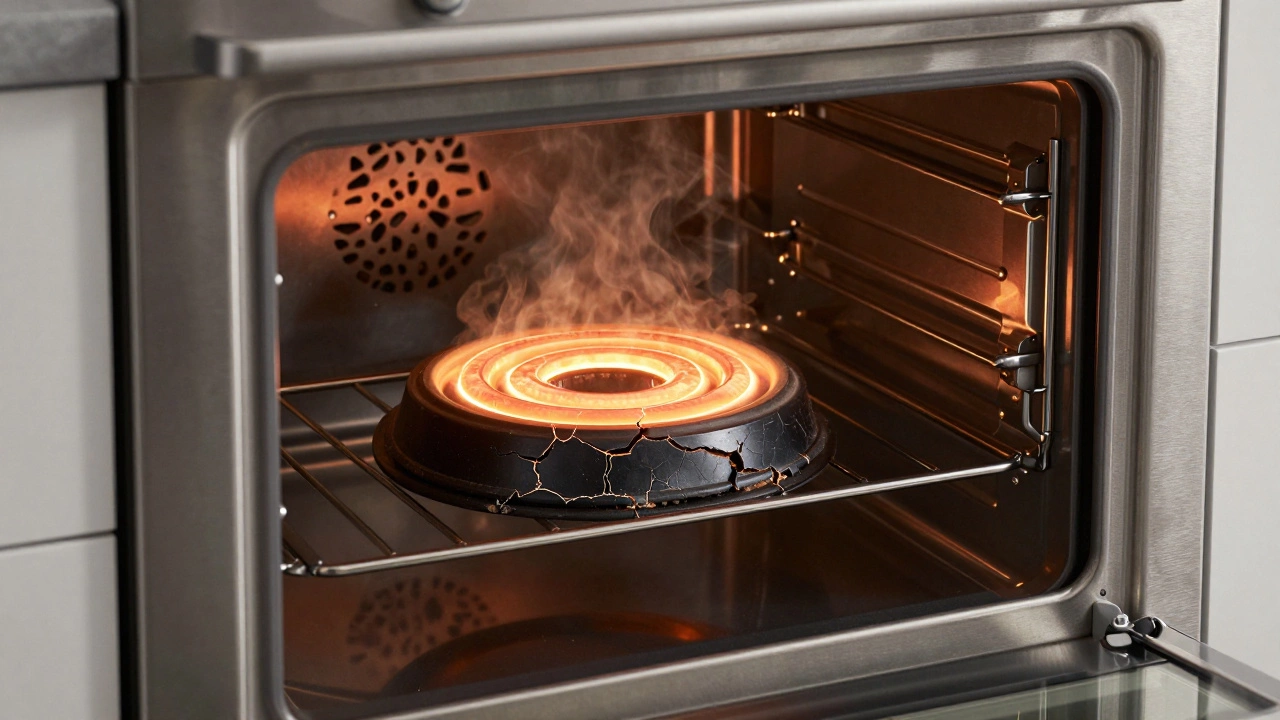
The bottom element (the one under the oven floor) is the most common culprit. Look inside the oven. If you see black spots, cracks, or sections that look burnt or sagging, that element is done. Even if it looks fine, try turning the oven on and watching it closely. A working element glows bright orange-red. If it stays dark while the top element glows, the bottom one is dead. Most electric ovens use two elements - one on top for broiling, one on bottom for baking. If only one isn’t working, you’ll notice uneven cooking.
It heats unevenly
One side of your cake is burnt, the other is raw. Your pizza crust is charred on the left, soggy on the right. That’s not your recipe. That’s your oven. Uneven heating usually points to a weak or failing heating element, or a broken fan in convection models.
Try this simple test: place three oven-safe thermometers on different racks - top, middle, bottom. Preheat to 180°C and wait 20 minutes. If one reads 160°C and another reads 200°C, your oven isn’t distributing heat properly. That’s not normal. In older ovens, this often means the bake element is losing power. In newer models with convection, the fan motor might be struggling. Either way, it’s not cooking right.
The oven light works but nothing else does
This one trips up a lot of people. If the interior light turns on when you open the door, you might assume the oven is getting power. But that’s not true. The light runs on a separate circuit. The oven itself needs 240 volts to operate. If your circuit breaker tripped, or one leg of the double-pole breaker failed, the light still works - but the oven won’t heat.
Check your home’s breaker panel. Look for the oven’s dedicated breaker. It’s usually a double switch side by side. If one side is flipped to the middle (between on and off), that’s the problem. Reset both switches firmly. If it trips again right away, there’s a short in the wiring or an element. Don’t keep resetting it. Call a technician.

The oven displays error codes
Modern electric ovens have digital displays that show error codes when something goes wrong. These aren’t random. They’re diagnostic tools. Common codes on brands like Bosch, Whirlpool, or LG include:
- F1 - Control board failure
- F3 - Temperature sensor fault
- F5 - Door lock malfunction (in self-cleaning models)
- E02 - Heating element issue
Don’t ignore these. Write down the exact code and look it up in your manual. Most manuals are available online if you’ve lost the paper copy. If the code points to the temperature sensor (thermistor), that’s usually a cheap fix - under $30 to replace. But if it’s the control board, you’re looking at a repair that might cost more than half the price of a new oven.
It smells like burning plastic or electrical burning
That weird, acrid smell isn’t just unpleasant - it’s a warning. If you smell something like melting plastic or hot wires, turn the oven off immediately. Unplug it if you can. This usually means:
- A wire is touching a hot surface and melting its insulation
- The internal wiring is frayed or corroded
- A component like the relay or transformer is overheating
Don’t wait to see if it goes away. This is a fire risk. Even if the smell stops after you turn it off, the damage is already there. An electric oven isn’t something you DIY when wires are involved. Call a licensed appliance technician. Don’t risk your home.

The oven door doesn’t seal properly
A loose, warped, or cracked door gasket lets heat escape. That makes the oven work harder to reach temperature, which can cause longer preheat times, inconsistent cooking, and higher electricity bills. You might not even notice the seal is bad until you feel warm air leaking out when the oven is on.
Check the gasket - that rubbery strip around the door edge. If it’s cracked, brittle, or falling off, it’s done. You can buy replacement gaskets online for most models. They’re easy to install. But if the door itself is bent or doesn’t close flush, that’s a bigger problem. It could mean the hinges are worn, or the frame is warped from heat. That’s harder to fix - and might mean it’s time to replace the whole oven.
It’s over 15 years old and acting up
Electric ovens last about 10 to 15 years on average. If yours is older than that and you’re starting to see multiple issues - the element burns out every year, the control panel glitches, the door won’t seal - you’re past the point of cost-effective repairs.
Think about it: replacing an element costs $50. Replacing a thermostat costs $80. But if you’re doing that every 18 months, you’ve already spent $300 in repairs. A new mid-range oven costs $600 to $800. New models are 30% more energy efficient. They have better temperature control. And they come with a 1-year warranty.
There’s no shame in replacing an old oven. It’s not a failure. It’s just physics. Things wear out. When your oven is older than your kids’ smartphones, it’s not broken - it’s just outdated.
What to do next
Here’s your quick checklist:
- Check the circuit breaker - reset both switches.
- Look at the heating elements - are they glowing? Any cracks or black spots?
- Use oven thermometers to test temperature accuracy.
- Read any error codes on the display.
- Smell for burning - if yes, turn it off and call a pro.
- Inspect the door seal - if it’s crumbling, replace it.
- Ask yourself: is this oven over 15 years old?
If you’ve checked all of these and still aren’t sure, take a photo of the inside of your oven - especially the elements and wiring - and show it to a repair technician. Most offer free diagnostics. Don’t guess. Get it right.
Can I fix my electric oven myself?
You can replace the heating element or door gasket if you’re comfortable with basic tools and turning off the power. But anything involving wiring, the control board, or temperature sensors should be left to a licensed technician. One wrong move can fry the whole system or start a fire.
Why does my oven take so long to preheat?
A slow preheat usually means the heating element is weakening, the thermostat is inaccurate, or the door seal is leaking heat. Older ovens also take longer because they’re less insulated. If it’s taking more than 20 minutes to hit 180°C, something’s wrong.
Is it worth repairing a 12-year-old oven?
It depends on the repair cost. If it’s under $150 and the oven still heats evenly, yes. But if you’re spending $200+ on parts and labor, and the oven is already 12 years old, you’re likely to face another problem in a year. Consider replacement instead.
How much does it cost to replace an oven element?
A replacement bake element costs between $25 and $50. Labor adds another $80 to $150 if you hire someone. DIY is easy - just unplug the oven, remove two screws, unplug the wires, and swap the part. Most elements are universal.
Can a faulty oven increase my electricity bill?
Yes. If the door seal is broken, the thermostat is faulty, or the element is struggling to reach temperature, the oven runs longer than it should. That can add $10 to $30 a month to your bill, depending on how often you use it.