Boiler Repair vs. Replacement Decision Tool
Your Boiler Details
Decision Analysis
Provide Your Details
Enter your boiler information and click analyze to get a personalized recommendation.
Factor Breakdown:
ℹ️ How This Works
This tool evaluates multiple factors including the 15-year rule, the 50% cost rule, efficiency ratings, safety concerns, and breakdown frequency to provide a balanced recommendation.
There is nothing worse than waking up to a cold house and a silent boiler on a freezing morning. You call a technician, they diagnose the issue, and then drop the hammer: "It could be fixed for $800, or you need a new unit for $4,000." The decision feels heavy. Do you throw good money after bad, or do you bite the bullet and upgrade?
The short answer is that it depends entirely on the age of your boiler, the central heating unit that heats water for your home's radiators and taps, the specific part broken, and your long-term plans for the property. There is no one-size-fits-all rule, but there are clear financial and safety signals that tell you which path to take.
The Age Factor: The 15-Year Rule
The single biggest factor in deciding whether to repair or replace is the lifespan of the unit. Most modern combi-boilers and system boilers have an expected lifespan of 10 to 15 years. If your boiler is older than 15 years, the probability of another major failure increases significantly every year.
Think of it like a car with 200,000 miles on the odometer. You can fix the transmission, but what about the engine next month? When a boiler passes its 15th birthday, it has likely exhausted its useful life. Manufacturers stop producing parts for older models, meaning repairs become more expensive and harder to source. In this scenario, repairing is often a temporary patch that delays the inevitable while draining your wallet.
If your boiler is under 10 years old, however, repair is usually the smarter move. These units are still within their prime operational window. A faulty component, such as a diverter valve or a pressure sensor, is likely an isolated incident rather than a sign of systemic collapse.
The Cost Comparison: Repair vs. Replacement
Money talks, so let’s look at the numbers. A typical boiler repair ranges from $150 for minor fixes (like a thermostat or fuse) to $800-$1,200 for major components (like a heat exchanger or pump). A complete boiler replacement, including installation, typically costs between $3,000 and $6,000 depending on the complexity and the type of system.
| Scenario | Estimated Cost | Lifespan Extension | Risk Level |
|---|---|---|---|
| Minor Repair (e.g., Thermostat) | $150 - $300 | Full remaining life | Low |
| Major Repair (e.g., Heat Exchanger) | $800 - $1,200 | 1-3 years | Medium |
| New Boiler Installation | $3,000 - $6,000 | 10-15 years | Low |
A useful heuristic here is the "50% Rule." If the cost of the repair exceeds 50% of the cost of a new boiler, replacement is almost always the better financial decision. Why spend half the price of a new unit just to keep an old, inefficient machine running for a few more months?
Efficiency and Energy Bills
Older boilers are notoriously inefficient. A boiler installed 20 years ago might operate at 70-80% efficiency, meaning 20-30% of the gas you burn is wasted up the flue. Modern condensing boilers, which have been mandatory in many regions for over a decade, achieve 90-95% efficiency.
This difference matters for your monthly bills. Replacing an old G-rated boiler with a modern A-rated model can reduce your heating bills by 20-30%. Over five years, those savings can offset the initial cost of the new boiler. If you are paying for a repair on an inefficient unit, you are also committing to higher ongoing fuel costs.
Consider the environmental impact too. Less waste means lower carbon emissions. If sustainability is a priority for your household, upgrading to a high-efficiency model or even a hybrid heat pump system is a step in the right direction.
Safety Concerns: Carbon Monoxide Risks
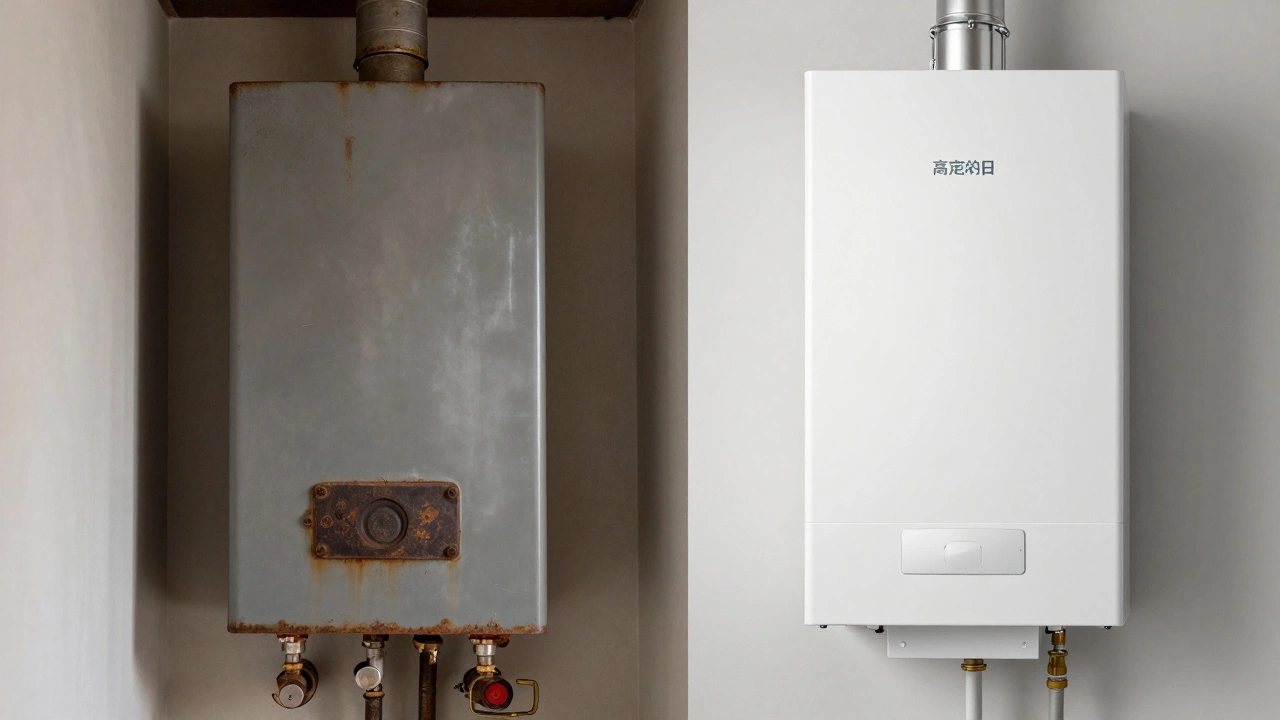
Boilers deal with combustion, which means they produce carbon monoxide-a colorless, odorless, and deadly gas. Older boilers are more prone to cracks in the heat exchanger or blockages in the flue, both of which can lead to dangerous leaks.
If your technician mentions any issues related to the heat exchanger, flue integrity, or irregular flame patterns, do not hesitate. Safety should never be gambled. Even if a repair is cheap, the risk of carbon monoxide poisoning makes replacement the only responsible choice for aging units.
Regular servicing helps catch these issues early, but if your boiler hasn’t been serviced annually, assume the worst. An unserviced boiler over 10 years old is a ticking time bomb.
Frequency of Breakdowns
How often does your boiler break down? If this is the first major issue in three years, repair is likely fine. But if you’ve had to call a technician twice in the last 12 months, the pattern is clear: the system is failing.
Frequent breakdowns indicate underlying wear and tear. Each repair addresses a symptom, not the root cause. Eventually, the cumulative cost of repairs will exceed the cost of a new unit, and you’ll still end up with a unreliable system. Consistent reliability is worth the investment in a new appliance.
Future Plans: Selling vs. Staying
Your timeline for living in the home plays a role. If you plan to sell your house in the next 1-2 years, a new boiler can be a selling point. Buyers prefer homes with updated systems because it reduces their immediate maintenance burden. However, a brand-new boiler rarely offers a full return on investment in resale value.
If you’re staying put for another 10+ years, replacement is a no-brainer. You’ll benefit from the efficiency savings, reliability, and warranty coverage for the duration of your stay. If you’re moving soon, a targeted repair might suffice, provided the unit is safe and functional.
When Repair Makes Sense
Despite the push for replacements, there are scenarios where repair is the logical choice:
- Young Boilers: Units under 8 years old with minor faults.
- Warranty Coverage: If your boiler is still under manufacturer warranty, repairs may be free or low-cost.
- Budget Constraints: If you cannot afford a new system now, a repair buys you time to save up.
- Simple Fixes: Issues like airlocks, frozen condensate pipes, or failed thermostats are cheap to fix and don’t signal impending doom.
When Replacement Is Essential
Conversely, you should lean toward replacement if:
- Age > 15 Years: The unit is near or past its expected lifespan.
- High Repair Costs: The quote is over $800 for a non-warranted unit.
- Inefficiency: Your bills are skyrocketing despite normal usage.
- Safety Issues: Any mention of carbon monoxide risks or heat exchanger cracks.
- Frequent Breakdowns: More than two service calls in a year.
Making the Final Decision
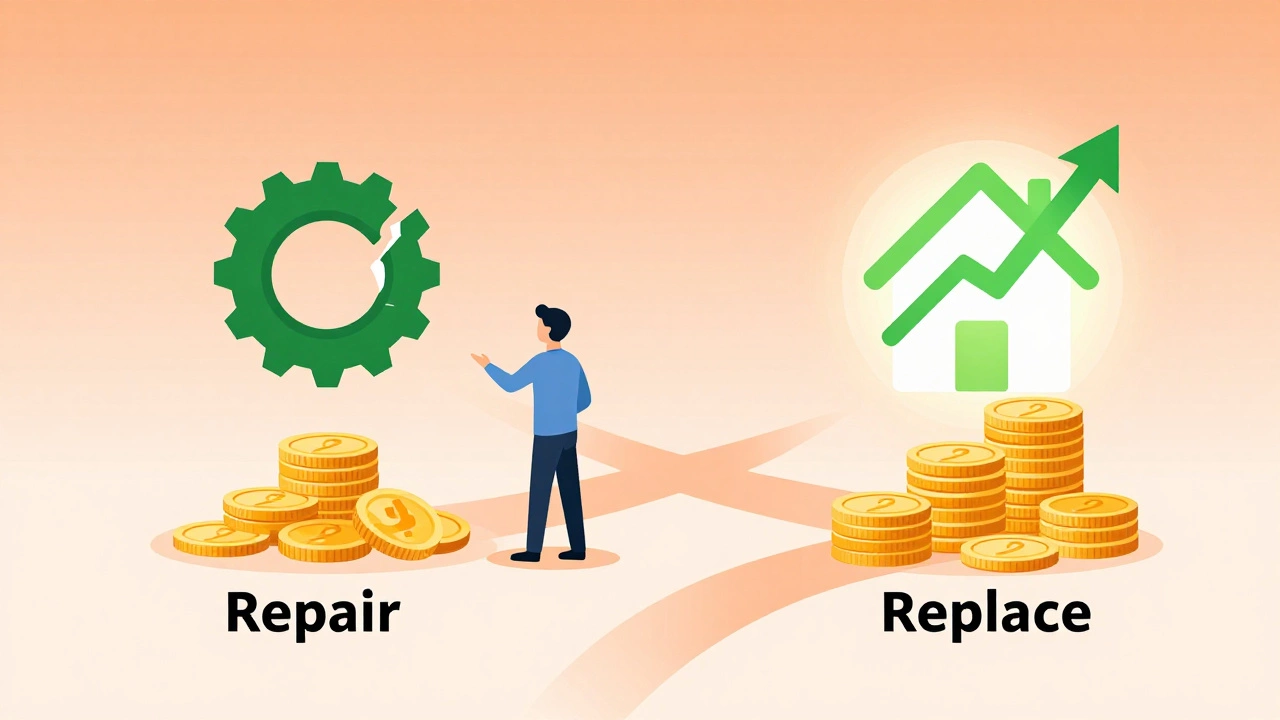
Ultimately, the decision comes down to balancing immediate costs against long-term value. Ask yourself: "Will this repair solve the problem permanently, or am I just delaying the inevitable?" Get at least three quotes for both repair and replacement to ensure you’re getting fair pricing. Don’t rush into a decision during an emergency; if possible, get a second opinion.
Remember, a boiler is a critical home system. Investing in a reliable, efficient unit pays off in comfort, safety, and savings. But if your current unit is young and healthy, a sensible repair keeps you warm without unnecessary expense.
How long do most boilers last?
Most modern boilers last between 10 and 15 years with regular annual servicing. Some high-quality units can reach 20 years, but efficiency drops significantly after the 15-year mark.
Is it cheaper to repair or replace a 12-year-old boiler?
For a 12-year-old boiler, repair is often cheaper upfront. However, consider the risk of future failures and reduced efficiency. If the repair cost is under $500, fixing it is reasonable. If it’s higher, replacement might be more economical in the long run.
What are the signs my boiler needs replacing?
Signs include frequent breakdowns, rising energy bills, unusual noises (kettling), yellow flames instead of blue, and visible corrosion or leaks. If your boiler is over 15 years old, these signs strongly suggest replacement.
Can I extend the life of my boiler with maintenance?
Yes. Annual servicing by a qualified technician cleans out debris, checks pressure levels, and ensures safe operation. This can add several years to the lifespan and maintain peak efficiency.
Does a new boiler increase home value?
A new boiler doesn’t directly increase market value dollar-for-dollar, but it makes your home more attractive to buyers. It removes a major maintenance concern and assures buyers of efficient heating.